Services
Seven engineering disciplines for power systems: sizing, calculations, equipment design, production, documentation, test & commissioning, system responsibility.
Seven disciplines, applied together. Independent engineering across the whole power system lifecycle.
A power system needs seven engineering disciplines working in concert. Most consultancies do one or two and pass the rest to the customer. We do all seven, because the disciplines interact — HVAC affects acoustics, acoustics affects enclosure, enclosure affects seismic anchorage, seismic affects control strategy. Break the chain at any single link and the system surprises you on site.
The seven services
1. Sizing
Right product, right capacity, right specification. Load profile analysis, derating (altitude / temperature / fuel), redundancy strategy, future-expansion projection. ISO 8528, NFPA 110, IEEE 446.
2. Calculations
No skipped numbers. Capacity, electrical (load flow + arc flash + harmonics), HVAC (radiator fan static pressure included), acoustic (intake / room / exhaust paths), seismic, fuel and pressure calculations. Licensed software plus empirical validation.
3. Equipment Design
Enclosure, silencer, fuel tank, P&ID — all the physical equipment. Nine disciplines: enclosure, exhaust silencer & stack, fuel tank (KIWA / EN / BS / UL / API flexible), fuel polishing, single-line & synchronisation, acoustics (intake / room / exhaust), HVAC + louvers + ducting, P&ID, switchgear.
4. Production
We design; a certified partner network builds. No vertical-OE dependency. ISO 9001, EN 1090, ASME welding, AWS qualifications, CE marking, API Q1 where required. Our engineer is on the partner shop floor during build — our design, our quality sign-off.
5. Documentation
Every calculation traceable. Every design version controlled. ISO 9001 (document control), ISO/IEC 17025 (test & calibration), IEC/ISO 81346 reference designation (KKS), customer-specific document formats (NEBB, NETA, Uptime).
6. Test & Commissioning
Factory acceptance (FAT), site acceptance (SAT), integrated system test (IST). Test plan, witness testing, test rig design + documentation, performance verification. NETA ATS, ISO 8528-5, NFPA 110 Ch.8, ASHRAE Guideline 0/1.1, Uptime Institute Tier methodology.
7. System Responsibility — at every stage, not the last one
Product-Safety mindset: risk identification, analysis, mitigation, verification, monitoring over the system lifecycle. ISO 12100, ISO 13849, IEC 61508, EU Machinery Regulation 2023/1230. HAZOP and FMEA methodology applied — but applied at every stage of the workflow above, not as a separate post-design audit.
How the disciplines interact
The reason we do all seven together is that they affect each other constantly:
- HVAC ↔ Acoustics. Radiator fan jet noise consumes acoustic budget; acoustic louver pressure drop consumes HVAC budget.
- Enclosure ↔ Seismic. Seismic anchorage must integrate with enclosure wall; acoustic panel and seismic mount must be co-designed.
- Fuel system ↔ Fire (FPE coordination). EN 13160 leak detection, NFPA 30 bunding strategy; fire suppression design is by the FPE but the fuel-side detection is ours.
- Switchgear ↔ Synchronisation. Paralleling switchgear, sync-check schemes, ATS make/break strategy.
- Sizing ↔ HVAC. Block-load capacity drives radiator fan static-pressure margin.
Single-discipline firms get their slice right and then fail at the interfaces. Our advantage is that we own the interfaces from day zero.
Workflow & safety loop
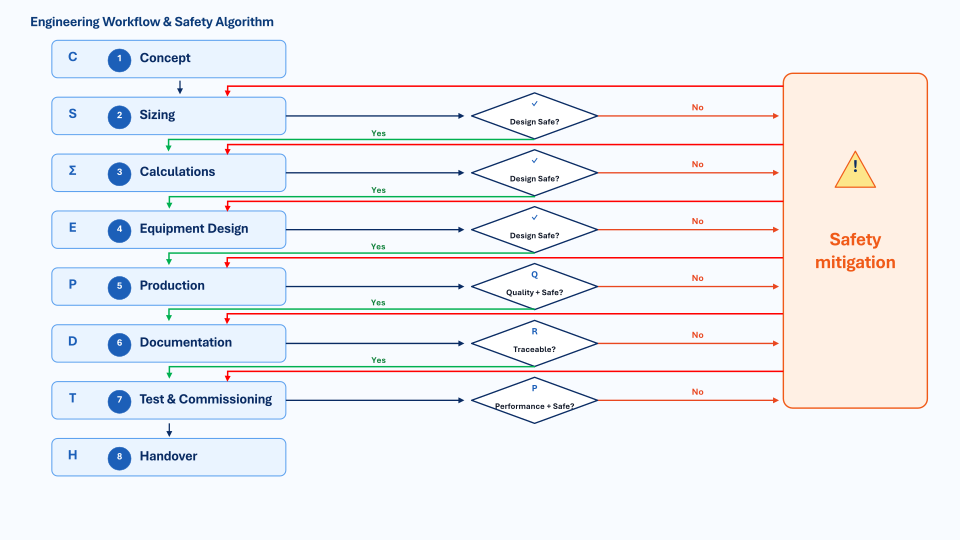
System responsibility is not the final step — it runs through every stage. At each stage we ask the gate question (design safe? quality + safe? traceable? performance + safe?); a “no” loops back into safety mitigation before the next stage starts. No stage begins until the previous one is frozen.
Send a brief
You may need one of these services, or all seven. We will tell you. Send your project brief and we will propose the scope.